LMT — The defense compounder trading at a 22% discount to its peer group

LMT — The defense compounder trading at a 22% discount to its peer group

Lockheed Martin passes all 3 screening gates: ROE 85.96%/81.05%/76.87% (FY2023–25), positive FCF every year ($5.3B–$7.7B), trailing P/E 26.20× — 22% below defense peer median. Bull/bear framework included.

US Stock Pick: 3-Year ROE > 15%
2026/6/13 · 21:22
1 订阅 · 28 内容
Screening result: all 3 hard criteria pass. Trailing 3-year ROE above 15% — confirmed, at 85.96% / 81.05% / 76.87% for FY2023–FY2025, with the caveat that $24.7B in cumulative buybacks compresses the equity base (ROIC of ~22% is the more honest capital-efficiency signal). Positive free cash flow — confirmed, every year since at least FY2021, ranging from $5.3B to $7.7B annually. Reasonable valuation — confirmed, trailing P/E of 26.20× sits 22% below the defense prime peer-group median of 33.42×, and the forward P/E of 17.73× is the lowest in the group. The central question is whether the margin compression and rising debt of recent years are structural deterioration or the cost of scaling up for a multi-year defense spending surge.
Lockheed Martin Corporation (NYSE: LMT) closed June 12, 2026 at $540.33, up 18.3% over the trailing 52 weeks against a 52-week range of $410.11–$692.00. Market cap: $124.6B. 1

What Lockheed Martin actually does

Lockheed Martin (founded 1995 via merger of Lockheed Corporation and Martin Marietta, headquartered in North Bethesda, Maryland) is the world's largest defense contractor by revenue, with $75.1B in FY2025 sales and approximately 123,000 employees. The U.S. government — primarily the Department of Defense — accounts for roughly 70% of revenue; the remaining 30% comes from foreign military sales and international direct commercial sales. 2
Revenue runs through four business segments:
  • Aeronautics (~40% of revenue): Fighter aircraft, primarily the F-35 Lightning II (the only fifth-generation multirole stealth fighter available for export), plus the F-16, F-22 sustainment, and C-130 transport aircraft.
  • Missiles & Fire Control (MFC) (~17% of revenue): Precision munitions, air-defense interceptors (PAC-3/Patriot missile seeker, THAAD — Terminal High Altitude Area Defense, JASSM/LRASM cruise missiles), tactical missiles, and fire control systems.
  • Rotary & Mission Systems (RMS) (~24% of revenue): Sikorsky helicopters (Black Hawk, CH-53K King Stallion, Seahawk), submarine combat systems, radar systems, and C4ISR (command, control, communications, computers, intelligence, surveillance, and reconnaissance) integration.
  • Space (~19% of revenue): Ballistic missile defense, GPS III satellites, Orion crew vehicle, hypersonic weapons, and classified Space Force programs.
The competitive moat rests on three structural pillars that collectively take decades to build: (1) a monopoly on fifth-generation multirole stealth fighters available for allied export — the F-35 program covers 12 nations with nearly 1,300 aircraft in service; (2) a large portfolio of classified programs that create unverifiable but very real barriers to entry; and (3) over 60 years of U.S. Navy submarine combat-systems integration experience, recently extended to Australia's Virginia-class nuclear submarine fleet under the AUKUS treaty. 3 S&P Global Ratings rates Lockheed's business risk profile as "Strong," citing its capabilities in aircraft, missiles, missile defense, and systems integration as well aligned with U.S. strategic priorities. 4

Screening criteria: the three gates

正在加载统计卡片…

Gate 1 — ROE track record

The channel screens for ROE above 15% in each of the past three fiscal years. LMT clears the gate by a wide margin — the mechanism matters.
Fiscal yearNet incomePeriod-end equityROEGate
FY2023 (Dec 31, 2023)$6,920M$6,835M85.96%
FY2024 (Dec 31, 2024)$5,336M$6,333M81.05%
FY2025 (Dec 31, 2025)$5,017M$6,721M76.87%
TTM (through Q1 2026)$4,793M$7,489M67.46%
Net income cross-verified via SEC XBRL (CIK 0000936468). 5 2
Why the ROE is this high — and what it does and doesn't tell you. Lockheed returned $24.7B to shareholders via share buybacks over FY2021–FY2025, reducing stockholders' equity from $10,959M to $6,721M — a 38.7% reduction in the denominator — while net income in FY2023 peaked at $6,920M. When net income approaches or exceeds equity, triple-digit ROE becomes arithmetic. ROIC (return on invested capital, which adds debt back to the denominator) runs at roughly 22% for FY2025 — a more informative signal of underlying capital efficiency that does not depend on buyback activity. 1 By comparison, the ROA (return on assets) has contracted from 15.02% in FY2021 to 10.56% TTM, reflecting rising assets and declining absolute profits.
Note also the trajectory: ROE has declined from 85.96% to 67.46% over the window. The decline reflects both a falling net income numerator (from $6,920M in FY2023 to $4,793M TTM) and some equity recovery. The screen passes on the letter of each year's result, but the direction of travel is downward.

Gate 2 — Free cash flow

FCF is operating cash flow minus capital expenditures. LMT has generated positive FCF in every year without exception over the five-year window.
正在加载图表…
PeriodOperating CFCapExFCFYoY
FY2021$9,221M$1,522M$7,699M
FY2022$7,802M$1,670M$6,132M−20.3%
FY2023$7,920M$1,691M$6,229M+1.6%
FY2024$6,972M$1,685M$5,287M−15.1%
FY2025$8,557M$1,649M$6,908M+30.7%
TTM (Q1 2026)$7,068M$1,706M$5,662M
Cash flow data from SEC XBRL and StockAnalysis. 5 6
TTM FCF of $5,662M at the current market cap of $124.6B produces an FCF yield of 4.54%. The $13.80 annual dividend per share requires approximately $3.1B in cash annually — FCF covers it 1.8× at the TTM run rate. 1
S&P Global Ratings projects FCF above $6.5B in 2026, citing favorable demand and recent U.S. tax law changes even as capital expenditures are expected to rise to approximately $2.7B annually in 2026–2027 to fund production scale-up. 4 CapEx rising from $1.7B to $2.7B per year is a real headwind to FCF, and investors should treat S&P's $6.5B+ forecast as a projection, not a floor.

Gate 3 — Valuation

Two tests: against LMT's own history and against defense prime peers.
vs. 5-year history
The historical P/E comparison carries a methodology caveat: StockAnalysis reports a trailing P/E of 26.20× (using $540.33 closing price ÷ TTM diluted EPS of $20.62), corroborated by Finviz at 26.17×. Macrotrends reports the current ratio as 21.20×, likely using basic rather than diluted EPS. For peer comparison purposes, the StockAnalysis / Finviz 26.20× figure — based on standard diluted TTM GAAP EPS — is the more appropriate reference. 7 1
The 5-year historical P/E range for LMT runs roughly 16–22×. At 26.20×, the current trailing multiple sits modestly above that historical band — a meaningful flag, offset by the forward P/E of 17.73× (which implies substantial EPS growth from the current $20.62 TTM to consensus ~$30+ for FY2026). The P/FCF of 22.00× compares to a Macrotrends 5-year average of ~18.1×, about 21% above the own historical average. 8
vs. defense prime peers (all data June 12, 2026) 1 9 10 11 12 13
TickerTrailing P/EForward P/EEV/EBITDAP/FCFPEG
LMT26.20×17.73×17.93×22.00×0.96
NOC (Northrop Grumman)17.22×19.43×12.75×23.65×3.29
GD (General Dynamics)22.67×21.40×15.95×15.71×2.40
LHX (L3Harris Technologies)33.42×25.48×16.55×22.15×1.39
RTX (RTX Corporation)34.43×26.59×18.30×29.23×2.56
GE (GE Aerospace)41.63×43.26×32.67×46.93×2.87
Peer median (excl. GE)33.42×25.48×16.55×22.15×2.56
LMT at 26.20× trailing P/E is 21.6% below the peer median of 33.42×. The forward P/E of 17.73× is the lowest in the group. PEG of 0.96 — below 1.0, meaning the market is paying less than 1× per unit of earnings growth — is also the lowest among peers, where the next-lowest (LHX at 1.39×) is still 45% higher.
A note on P/B: LMT's P/B of 16.59× is far above the peer range of 2.92–4.57×, but this reflects accounting equity erosion from $24.7B in cumulative buybacks, not market mispricing. EV/EBITDA and P/FCF are the meaningful valuation metrics for LMT. At 17.93× EV/EBITDA, LMT sits modestly above the peer median of 16.55×. P/FCF of 22.00× is essentially at the peer median of 22.15×.

Revenue and earnings

正在加载图表…
Revenue and net income data from SEC XBRL. 5
PeriodRevenueYoYNet incomeOp. marginNet margin
FY2021$67,044M$6,315M13.61%9.42%
FY2022$65,984M−1.6%$5,654M12.65%8.57%
FY2023$67,571M+2.4%$6,920M12.59%10.24%
FY2024$71,043M+5.1%$5,336M9.87%7.51%
FY2025$75,048M+5.6%$5,017M10.30%6.69%
TTM (Q1 2026)$75,106M$4,793M9.88%6.38%
Revenue is growing at a 4-year CAGR of ~2.9% and accelerating in FY2024–FY2025 (both above 5%). The challenge is that net income peaked at $6,920M in FY2023 and has since fallen 30.7% to a TTM of $4,793M — a significant divergence from the revenue trend. 2
Two factors drive the profit contraction. First, operating margins have compressed from 13.61% (FY2021) to 9.88% (TTM) — largely reflecting cost growth on fixed-price development contracts and execution issues in Aeronautics (particularly F-16 and C-130). Second, interest expense has nearly doubled: $569M in FY2021 to $1,119M TTM, as total debt increased from $11.7B to $20.7B. 5 S&P's assessment is that "the structure of the agreements supports Lockheed's ability to maintain cash flow neutrality through the expansion period, though we expect some margin compression." 4
Q1 2026 results (reported April 23, 2026): Revenue $18.0B, flat year-over-year. EPS $6.44, below analyst consensus of $6.67–$6.79 and down 11.5% from $7.28 in Q1 2025. Free cash flow was −$291M versus $955M in Q1 2025, primarily due to working-capital disruption from a new ERP (enterprise resource planning) system implementation. Management reaffirmed full-year 2026 guidance of revenue $77.5–$80.0B, EPS $29.35–$30.25, and FCF $6.5–$6.8B. 14 The guided full-year EPS of ~$29.80 at the midpoint implies roughly 44% earnings growth from the TTM EPS of $20.62, which explains the sharp gap between the 26.20× trailing P/E and the 17.73× forward P/E.

The F-35 program

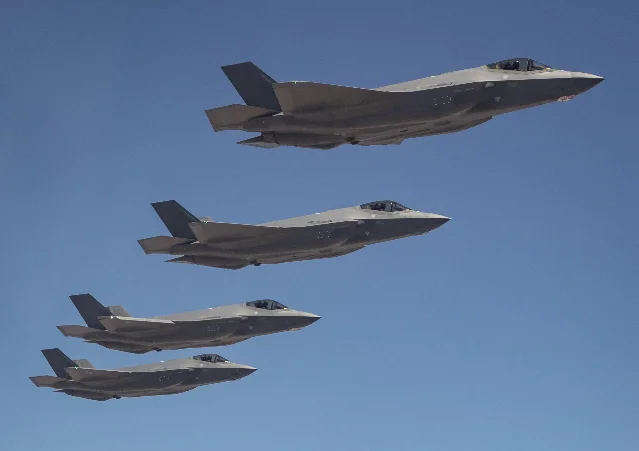
F-35 deliveries reached 191 aircraft in 2025 — a program record, more than the 142 delivered in the prior record year, and roughly 5× the annual production rate of any comparable allied fighter program. 15
Four F-35A Lightning II jets in close formation against a clear blue sky
F-35A Lightning II formation, 2025 delivery year. U.S. Air Force photo. 15
The Lots 18–19 production agreement — up to 296 jets valued at $24B — is the largest single production contract in the program's history. 15 The F-35 generates roughly 25–30% of LMT's total revenue, making it simultaneously the company's greatest competitive asset and its largest single-program concentration risk. International demand continues to expand — Italy and Denmark added 25 and 16 aircraft respectively — but Switzerland trimmed its order from 36 to approximately 30 jets due to a cost overrun of approximately 1.1 billion Swiss francs ($1.4B), a reminder that allied budget pressures can produce order revisions even for programs with no comparable substitute. 16

Balance sheet

MetricValue (TTM)Context
Total debt$20,697MUp from $11,670M in FY2021
Stockholders' equity$7,489MDown from $10,959M in FY2021
D/E ratio2.76×Rising from 1.06× in FY2021
Cash$1,894MNet debt −$18,803M
Interest coverage5.99×Down from 16.03× in FY2021
Current ratio1.14Down from 1.42 in FY2021
Balance sheet data from SEC XBRL and StockAnalysis. 17 1
The deterioration across all three balance-sheet ratios over four years is real and worth taking seriously. Total debt nearly doubled — funded by a combination of share repurchases ($24.7B since FY2021) and capital investment — while operating income has compressed, reducing interest coverage from 16× to 6×. An interest coverage ratio of 5.99× is still adequate, but the direction of travel is the opposite of what a bondholder wants to see.
The credit market, however, has reached a different conclusion. S&P rates LMT A−/A-2 with Positive outlook (revised upward May 28, 2026). Moody's rates LMT A2 with Stable outlook (upgraded from A3 in August 2023). Fitch rates LMT A/F1 (confirmed July 2025). All three agencies sit LMT in the lower single-A band — five to six notches above speculative grade. 4 The key to this apparent contradiction: S&P's adjusted debt/EBITDA for LMT is 2.0× (FY2025) — a much more conservative measure than the GAAP D/E of 2.76× — because S&P incorporates pension and lease adjustments that reflect the actual economic debt load. S&P stated: "The positive outlook reflects our expectation that Lockheed will maintain leverage below 2x and funds from operations (FFO) to debt above 45% as strong demand for defense products supports strong earnings and cash flow." 4 A potential credit upgrade within 12–24 months would reduce LMT's borrowing costs and, at a minimum, take off the table the risk of a rating downgrade acting as a headwind.
A separate balance-sheet context item: following a January 2026 executive order from the Trump administration criticizing defense contractors for prioritizing stock buybacks, Lockheed has largely suspended share repurchases. S&P incorporates a $3B annual buyback placeholder in its FY2026 forecast as a normalization assumption and notes that credit metrics would improve further if no buybacks occur. 4 The pause is a near-term headwind to EPS support, but it also gives LMT more cash to reduce debt.

Dividends and shareholder return

LMT has increased its dividend for 23 consecutive years, paying $13.80 per share annually (2.55% yield at the current price). 18 The 3-year dividend CAGR is 5.4%; the 5-year CAGR is 6.4%. The most recent quarterly dividend of $3.45/share was declared May 12, 2026, with an ex-dividend date of June 1, 2026. Payout ratio at the TTM level is 66.2% — elevated but covered by FCF at 1.8× coverage. 1
Total shareholder yield (dividend 2.55% + current buyback yield 2.18%) runs 4.73%, which leads the defense peer group: Northrop Grumman at 3.72%, General Dynamics at 2.91%, L3Harris at 2.74%, and RTX at 0.56%. 1

Risk factors

F-35 program concentration. The F-35 accounts for roughly 25–30% of total revenue. Any production disruption, delivery rejection, or customer order reduction goes directly to the top line — there is no other single program or segment that can absorb a hit of that magnitude. The Swiss order reduction is a data point, not just a hypothetical. 16
Execution on fixed-price contracts. Q1 2026 included $125M in unfavorable profit adjustments on the F-16 program (production performance and development delays) and $55M on the C-130 (supplier integration challenges). These are not isolated incidents: the operating margin contraction from 13.61% (FY2021) to 9.88% (TTM) reflects cumulative execution risk on a portfolio of fixed-price development contracts. 14
Classified program cash drag. LMT carries a portfolio of classified ("black budget") programs. The company's Q1 2026 earnings call indicated that these programs are expected to consume $500M–$700M in cash annually in 2026–2027 before the cash outflows decline significantly. This drag will suppress reported FCF below the headline operating cash flow during the scale-up period. 19
Defense budget path uncertainty. The Trump administration's proposed FY2027 defense budget of approximately $1.5 trillion — roughly 44% above the FY2026 level — is the bull case for LMT's forward demand. However, this proposal faces internal Republican resistance, and the actual appropriation path through Congress involves real uncertainty. 4 A materially smaller final defense budget would moderate the growth assumptions embedded in the forward P/E of 17.73×.
Rising capital expenditures. CapEx is projected to increase from $1.7B (FY2025) to approximately $2.7B annually in 2026–2027 to support the 3–4× scale-up in PAC-3, THAAD, and precision-munitions production. This expansion is funded by the government through multiyear supply agreements with inflation indexing and advance payments — but it still pressures near-term FCF and further increases the asset base that ROA must serve. 4
Insider ownership and recent transactions. Insider ownership is just 0.06% of shares outstanding. Recent insider transactions consist primarily of option exercises and modest open-market sales (including the Aeronautics president Greg Ulmer, who filed to sell 2,840 shares ahead of his May 2026 retirement). No pattern of open-market purchases. 1 Short interest is 1.15% of the float — low, meaning few professional bears are betting against the stock.

Near-term catalysts

  • Q2 2026 earnings — approximately July 21, 2026. 1 The Q1 FCF miss and ERP disruption will be the primary lens: did operating cash flow recover in Q2 as management projected? The FY2026 guidance of $29.35–$30.25 EPS requires a significant back-half earnings acceleration; any revision to guidance on July 21 drives the next material re-rating.
  • $186B order backlog. LMT's backlog of approximately $186B represents roughly 2.5 years of revenue coverage at the FY2025 run rate. This is not just a quantitative buffer — it limits LMT's exposure to any single budget cycle or political decision. Even if the FY2027 defense appropriation is significantly cut from the proposed $1.5T, existing contracts already in backlog continue to generate revenue. 4
  • AUKUS submarine program. In May 2026, LMT was named preferred combat systems integration partner for Australia's fleet of Virginia-class nuclear submarines under the AUKUS agreement. The first Australian vessel is expected in the 2030s, but the multidecade support contracts generate long-tailed revenue. 3
  • S&P potential credit upgrade. S&P's Positive outlook signals a possible upgrade from A− within 12–24 months if adjusted debt/EBITDA sustains below 2× and FFO/debt exceeds 45%. S&P projects this threshold is achievable in FY2026. A credit upgrade would reduce LMT's cost of debt and could attract institutional buyers with stricter rating minimums. 4
  • Analyst consensus. 22 analysts cover LMT with a Hold consensus (Finviz score 2.48 out of 5) and an average price target of $625.16 — implying 15.7% upside from the June 12 close. The 52-week high of $692.00 is 28.1% above current levels; the 52-week low of $410.11 is 24.1% below. The stock sits in the lower half of its trailing-12-month range. 20

Bull / bear framework

Bull case

1. The 22% peer discount is real and the forward multiple is genuinely low. At a trailing P/E of 26.20× against a peer median of 33.42×, LMT would need to reach 32.5× — still below the peer median — just to close half the gap. The forward P/E of 17.73× based on guided FY2026 EPS of $29.35–$30.25 is priced for a company with no growth, not one guiding for ~44% EPS expansion year-over-year. Management's credibility on this guidance rests entirely on the back half of 2026 delivering; if it does, the valuation is attractive at current prices. 1
2. $186B backlog plus a potential $1.5T defense budget is a multi-year demand runway. Defense spending is a political-priority-driven market, and the current U.S. and NATO posture is the most defense-oriented in decades. LMT's backlog already secures approximately 2.5 years of revenue. Incremental program wins from the proposed budget expansion — precision munitions scale-up, new classified programs, AUKUS — layer on top of a base that is already locked in. 4
3. FCF yield of 4.54% plus a 23-year dividend growth streak provides a durable income floor. For an income-oriented investor, LMT's 2.55% dividend yield on a 23-year growth streak with 1.8× FCF coverage is a meaningfully different risk profile than equities that depend on earnings growth to sustain the dividend. Total shareholder yield of 4.73% leads the peer group. Even if the multiple compresses, the underlying cash return provides a buffer. 18
4. Beta of 0.11 makes LMT a structural portfolio stabilizer. The 5-year beta of 0.11 means LMT's price moves are almost entirely uncorrelated with S&P 500 returns. In a broad equity selloff, LMT has historically held value or appreciated — a property that has real portfolio-level value independent of the specific LMT thesis. 1

Bear case

1. The trailing P/E of 26.20× is above LMT's own 5-year range of 16–22×. LMT has historically traded at a meaningful discount to where it is today. At 26.20×, investors are not buying at a historically cheap valuation relative to LMT's own track record — they are buying at a premium to history and betting that elevated defense spending will be sustained long enough to grow into the current multiple. If the defense budget expansion stalls or if margin recovery disappoints, the multiple has room to contract back toward the 5-year range. 7
2. The net income trend is heading the wrong way. Net income peaked at $6,920M in FY2023 and has since declined 30.7% to a TTM of $4,793M. Revenue is growing, but every dollar of top-line growth is generating less bottom-line profit due to margin compression and rising interest costs. The guided EPS recovery to $29–$30 in FY2026 requires execution on a back-half ramp that the Q1 2026 results did not start well. A second consecutive EPS miss would force a reassessment of the forward multiple.
3. Interest coverage has declined from 16× to 6× in four years. The combination of doubled debt and compressed operating income has meaningfully reduced LMT's financial flexibility. At 5.99× interest coverage, the company retains solid headroom, but the directional trend has moved consistently in one direction for four years. If operating margins do not recover — or if interest expense continues to rise — coverage could approach levels where the credit agencies would revisit the current A− rating in the wrong direction. 17
4. The EPS recovery thesis is heavily back-half weighted. Full-year guidance of $29.35–$30.25 after a Q1 EPS of $6.44 implies that Q2–Q4 2026 must average approximately $7.64–$7.94 per quarter. The Q1 FCF miss (−$291M vs. +$955M in Q1 2025) from ERP disruption adds execution uncertainty. If the ERP normalization does not materialize in Q2, or if additional fixed-price contract charges emerge, the full-year guidance cannot be met without extraordinary performance in Q3–Q4. 14

Operating data snapshot

MetricValueSource / date
Price$540.33June 12, 2026 close
Market cap$124.6B
Enterprise value$143.4B
52-week range$410.11 – $692.00
Trailing P/E26.20×StockAnalysis, June 12
Forward P/E17.73×StockAnalysis
EV/EBITDA17.93×StockAnalysis
P/FCF22.00×StockAnalysis
PEG ratio0.96StockAnalysis
FCF yield4.54%$5.66B / $124.6B
Dividend yield2.55%$13.80/share annual
Total shareholder yield4.73%Dividend + buyback
Beta (5Y)0.11StockAnalysis
Analyst consensusHold (22 analysts)Avg. target $625.16
Next earnings (est.)~July 21, 2026StockAnalysis (unconfirmed)

This article is for informational purposes only and does not constitute investment advice. All financial data sourced from SEC EDGAR XBRL, StockAnalysis.com, Finviz, Macrotrends, PR Newswire, S&P Global Ratings, Lockheed Martin Newsroom, Breaking Defense, and Yahoo Finance. Prices as of June 12, 2026 close. Investors should conduct their own due diligence before making any investment decisions.
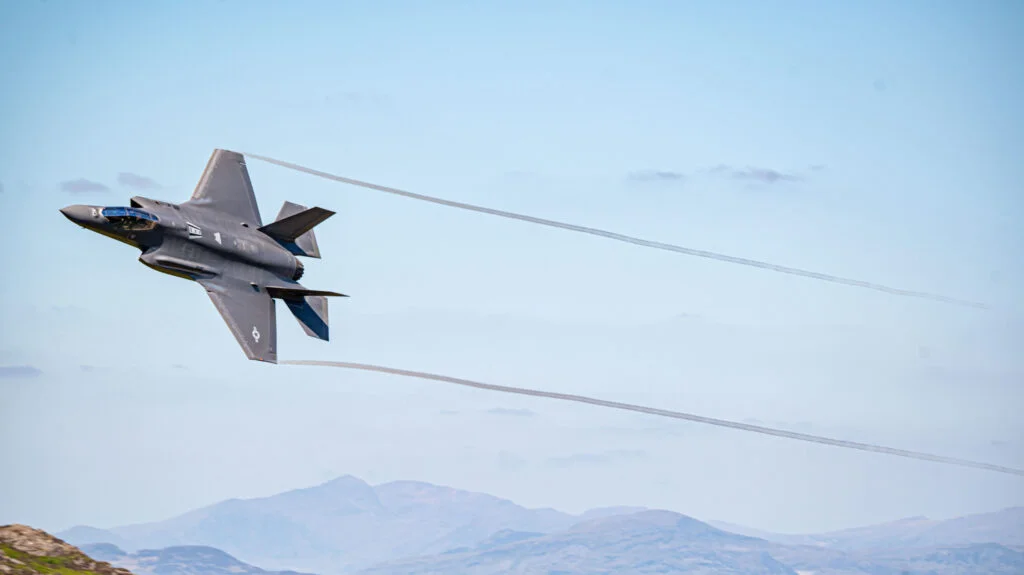
Cover image: F-35A Lightning II low-level flight, Mach Loop, Wales — U.S. Air Force photo, public domain.

围绕这条内容继续补充观点或上下文。

  • 登录后可发表评论。